
Nocellara del Belice: portrait of a Sicilian olive
A large round fruit, generous flesh, a green oil with a peppery finish. A portrait of one of the two varieties behind our oil.
· 4 min read
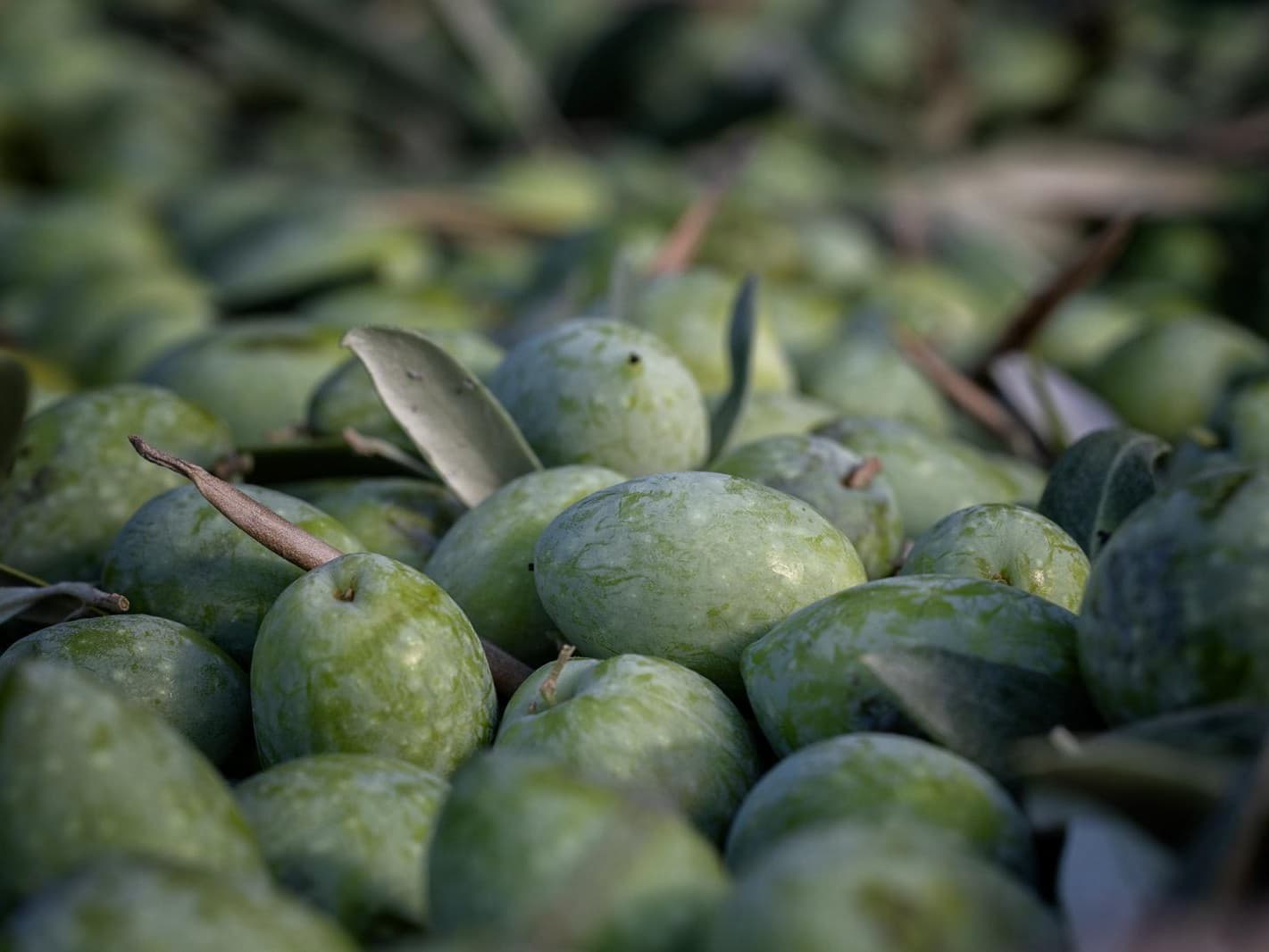
Nocellara del Belice is one of the great olive varieties of Sicily. Together with Tonda Iblea, it is also one of the two varieties in our oil. Here is where it comes from, what it looks like and what it brings to your plate.
Where Nocellara del Belice comes from
The name tells you its origin. The Belice is a valley in western Sicily, around Castelvetrano. That is where the variety took hold, generation after generation. It shaped a whole landscape of olive groves.
Today it is grown far beyond its home valley. You find it across the island, all the way to the south east. That is our case, near Noto, on the foothills of the Hyblaean Mountains. A western variety, planted at the other end of the island, on a different soil.
A round, fleshy fruit
Nocellara is easy to spot. The fruit is large, almost round, with thick flesh. The skin stays bright green for a long time. It then turns purple, and black when fully ripe.
That generous flesh makes it a dual purpose variety. It works at the table as well as at the mill. Outside Italy, you often meet it in delis as the Castelvetrano olive: green, crisp and mild.
For oil, it is another story. Picked early, while the fruit is still green, it gives an oil with real character. That is our choice, at the start of the harvest, in October.
Picking date changes everything. The longer you wait, the riper the fruit and the rounder, milder the oil. The earlier you pick, the greener, more bitter and more peppery it gets. A green olive also holds less oil: you need more fruit to fill a bottle. That is the price of freshness.
Among Sicilian olives
Sicily has many olive varieties. Among the best known are Biancolilla, Cerasuola and Tonda Iblea, which comes precisely from the Hyblaean Mountains. Each has its own character and its own territory. Tasting these varieties side by side is still the best way to train your palate.
Nocellara stands out for its versatility. You can eat it, press it, and it adapts to many terroirs. Its oil, when the olives are picked green, offers a grassy, generous fruitiness. That personality is what won us over.
The taste of Nocellara
A Sicilian olive oil made from green Nocellara has a green fruitiness. You often find vegetal notes: freshly cut grass, tomato leaf, artichoke. Then comes a clear bitterness and a pepperiness that rises at the finish.
Our oil, where it meets Tonda Iblea, follows that profile. On the nose, cut grass and tomato leaf. On the palate, raw artichoke, green almond and a light bitterness. On the finish, white pepper, with a fine and lasting heat.
These sensations are not flaws. Bitterness and pepperiness are typical of a young oil made from green olives. They soften over time, as the oil ages.
How to taste it
To really taste it, pour a little oil into a small glass. Cover it with your hand and warm it for a moment. Smell it. Then take a small sip and draw a thread of air through your teeth. The aromas rise, the bitterness settles on the tongue, and the pepper comes last, at the back of the throat.
Noto terroir, from tree to mill
The same variety does not give the same oil everywhere. Soil, climate and harvest date matter as much as the tree. In Noto, the soil is limestone, sometimes rocky, rich in minerals. Summers are hot and dry, winters mild. Rain falls mostly in spring and autumn.
That range favours olives with a high aromatic concentration. Our olive trees are over a hundred years old. To see this landscape, read our page on the Noto terroir.
Planting a western variety in the south east means accepting it will speak with another accent. Nocellara from Noto keeps its character, but it also carries the mark of its land.
Then comes the craft. Our olives are picked by hand, early in the harvest. They are cold pressed. The shorter the wait, the less the fruit suffers, and the better the fresh aromas are kept. The oil is then naturally filtered.
In our oil it is paired with Tonda Iblea, the variety of the Hyblaean Mountains. No other origin. What you taste comes from our trees near Noto, and nowhere else. Our approach is told in our story.
Using it in the kitchen
A green Nocellara oil is a finishing oil. It shines raw, poured at the last moment. A few simple ideas:
- On burrata, with a pinch of salt.
- On a tomato and anchovy bruschetta.
- On grilled vegetables, still warm.
- On a bean or lentil soup, just before serving.
- With good bread, simply.
In Sicily, it also goes on caponata, on an orange and fennel salad, or on pasta simply dressed with garlic and chilli. One spoonful is enough. The oil is not a cooking base, it is an ingredient in its own right.
Avoid long cooking. Heat wipes out what makes this oil worth it. It is made to reveal, not to hide.
To store it, keep the bottle away from light and heat, cap tightly closed. Once opened, it is best used within three months: air slowly oxidises it. Want to taste it? Discover our Sicilian extra virgin olive oil.
Frequently asked questions
- Is Nocellara del Belice a table olive or an oil olive?
- Both. It is a dual purpose variety. Its large, fleshy fruit is loved at the table, often sold as the Castelvetrano olive. Picked green, it also gives a fruity, peppery oil.
- What does Nocellara olive oil taste like?
- A green fruitiness, with notes of cut grass, tomato leaf and artichoke. The bitterness is clear and the pepperiness arrives at the finish. The intensity depends mostly on the harvest date.
- Why does olive oil sting the throat?
- That pepperiness is typical of a young oil made from olives picked early. It is part of the profile of a fresh oil. It fades over time.
- Can you cook with Nocellara olive oil?
- It is at its best raw. Long cooking wipes out its aromas. Keep it for dressing and finishing dishes.